How to Play
Suitable for players 6+
Steps:
1. For a range of 3-5 players, shuffle and deal 5 cards each.
2. A pick-up pile should be laid in the centre, all facing down except for the top card facing upwards and visible to all players.
3. Starting with the youngest player, each player should go around in a circle asking another player of their choice whether they have a card belonging to a particular group (such as 'Do you have any Boletes?'). If the player who has been asked does have a card within that group, they must hand it to the player who asked. If the second player has multiple of that group, then are able to choose which card within that group they want to hand to the first player. However if the second player has none, then the active player must pick up a card from the central pile.
4. Players should collect groups in their hand (defined by the colour of each card and the group name on the side).
5. Once a set is completed, it should be set down to obtain the number of points defined on each card by the number of mushrooms.
Rules:
- Players can only hold a maximum of 7 cards in their hand at any one time. If a player has more than 7 cards at the end of their go, then they must place the extra card(s) of their choice to the bottom of the pick-up pile.

In each deck
Each deck comes with 60 hand-illustrated cards and an informative booklet within a rigid box.
Each set is comprised of 4 cards, so whilst we suggest starting with 40 cards (10 sets and no wildcards) for younger players, you can add up to 4 more sets and 4 wildcards for increasing confidence and familiarity with the cards.

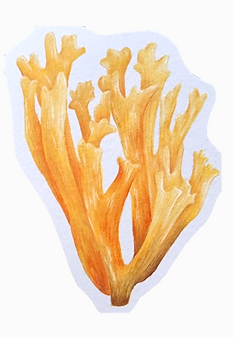


Each playing card depicts a different UK mushroom species in their habitat, alongside their common and scientific name, a fun fact, and the number of points they're worth.
Each card clearly shows any major features relevant to the identification of the group (e.g. the characteristic stipe shape of the Boletes).
Each set is distinguishable by the colour theme of the card and the name of the group along the side.
Within each set, there are also 4 wildcards, with mystery mushroom or scientific illustrations.
These can be used in place of a species card, if you're struggling to get the final card in a set, say.
The booklet is aimed to be both educational broadly and regarding the game.
As such, besides the clearly outlined rules and modifications that can be made to the game, there are introductions to each of the species, the features of the groups, and the background of phylogeny and taxonomy that put the game into scientific context.
Like the rest of the game, this box is hand-illustrated.
It is rigid to protect the cards and booklet
Why is MycoStrike necessary?
When trying to learn about Fungi myself, I've found many of the resources available to either be targeted at older audiences or those with a significant prior knowledge. Many popular science books do not go into much detail about what actually connects and separates species, whereas the more academic texts or those to aid identification offer little explanation of jargon.
Utilising fungi is likely to be increasingly important in the future to protect and maintain biodiversity, and as textiles or tools. As such, I believe it is important that young people can learn at a more accessible level.
Another benefit engaging children especially with the natural world is increasing desire to spend time outside to put their knowledge to the test. This is because there are so many benefits to children, such as helping their concentration and mental health, and increasing the desire to learn about how other taxa interact with fungi or the natural world more broadly.
Lastly, I believe that more widespread knowledge around the consequences of losing stable woodland communities would help put pressure on policymakers. Whilst now is a critical time to protect woodland due to the extent of the decrease in woodland cover, managing woodland is an issue that will always be relevant, and requires long term planning and cooperation. Creating a demand to get involved may help open opportunities such as grants or more frameworks for employers to reflect on their impact on woodland as standard practice.

How does it support The Woodland Trust?
Currently, the majority of information regarding fungi that is available in a more accessible science communication style relates specifically to mycorrhizal fungi and their interactions with plants. Whilst this is a huge step in terms of understanding how interconnected ecosystems really are and raising the profile of fungi, I want to make it obvious that fungi are interesting in their own right.
Fungi are pivotal to ecosystem services such as nutrient cycling, maintaining soil fertility and structure. They have been used as food or medicine through cultures around the world. Looking to the future, there’s been much progress in researching how the properties of fungi can be applied to combat Climate Change through harnessing carbon sequestration, and ecological challenges such as soil erosion and metal contamination. There is even research investigating sustainable alternatives to everyday products like packaging and clothing.
However, fungal biodiversity and ability to provide these ecosystem services is under threat due to challenges such as deforestation, changing land use, and soil degradation. We haven’t been able to progress in our understanding this far, and won’t be able to in the future without an awareness and appreciation both of their diversity and critical role in ecosystems.
Therefore, through MycoStrike, I hope to make fungi more of a talking point in everyday life and get people of all ages involved in the protection, restoration, and creation goals of the Woodland Trust for ancient woodland.

How does MycoStrike work?
The overall goal for MycoStrike is to introduce players to the idea that whilst some fungi that look similar can be closely related, this isn't always the case. Not only is there a huge variety in shapes, sizes, and lifestyles of fungi, but many distantly-related species have developed through 'convergent evolution' to look similar.
As such, the aim of the game is to collect as many points as possible. To do this, in a style similar to Happy Families, sets of 4 must be collected. The catch is that some of the sets are more closely related than others. The number of points (or number of small mushrooms in the corner from 1-3) indicates how closely related they are phylogenetically (in terms of how far back they diverged into different species). This goes from 1 point (the same order or a polyphyletic group), 2 points (the same family), or 3 points (the same genus). Whilst there are lots of card sets worth 1 or 2 points, only the highly prized Earthstars (genus Geastrum).
Through playing, the goal of the game is to familiarise players with the types of identification features looked at when studying Fungi and how incredible it is that whether closely related or not, the Fungal Kingdom is endlessly fascinating!

The illustrations (a sneak-preview)
Each of my illustrations are painted with gouache paint and the finest-tipped paintbrushes I can get my hands on! In real life, each of them is roughly palm-sized and takes approximately 3-4 hours to complete.
From when I originally started painting these as a gift for my partner, this project has grown more than I could have imagined!


